

Here is a fact that paint manufacturers hate to admit: You can buy the best epoxy in the world, apply it perfectly, and it can still fail within a month.
Why? Because of water you can’t even see.
If your concrete floor is holding moisture, that water vapour will eventually try to escape. When you seal the surface with a waterproof Epoxy Floor Paint, you trap that vapour. The pressure builds up (called hydrostatic pressure) until it literally pushes the paint off the floor. The result? Bubbles, blisters, and sheets of paint peeling up.
Before you spend a penny on paint, you must perform a moisture test for concrete floors. Here is how to do it properly.
Why Does Concrete Hold Water?
Concrete is a hard sponge. Even if the surface looks bone dry, the slab underneath could be saturated.
-
New Concrete: A new slab takes 28 days just to cure, but months to fully dry out.
-
No Vapour Barrier: Many older garages (pre-1980s) were built without a damp-proof membrane (DPM) underneath. They constantly suck moisture up from the ground like a wick.
Method 1: The Plastic Sheet Test (The Free DIY Method)
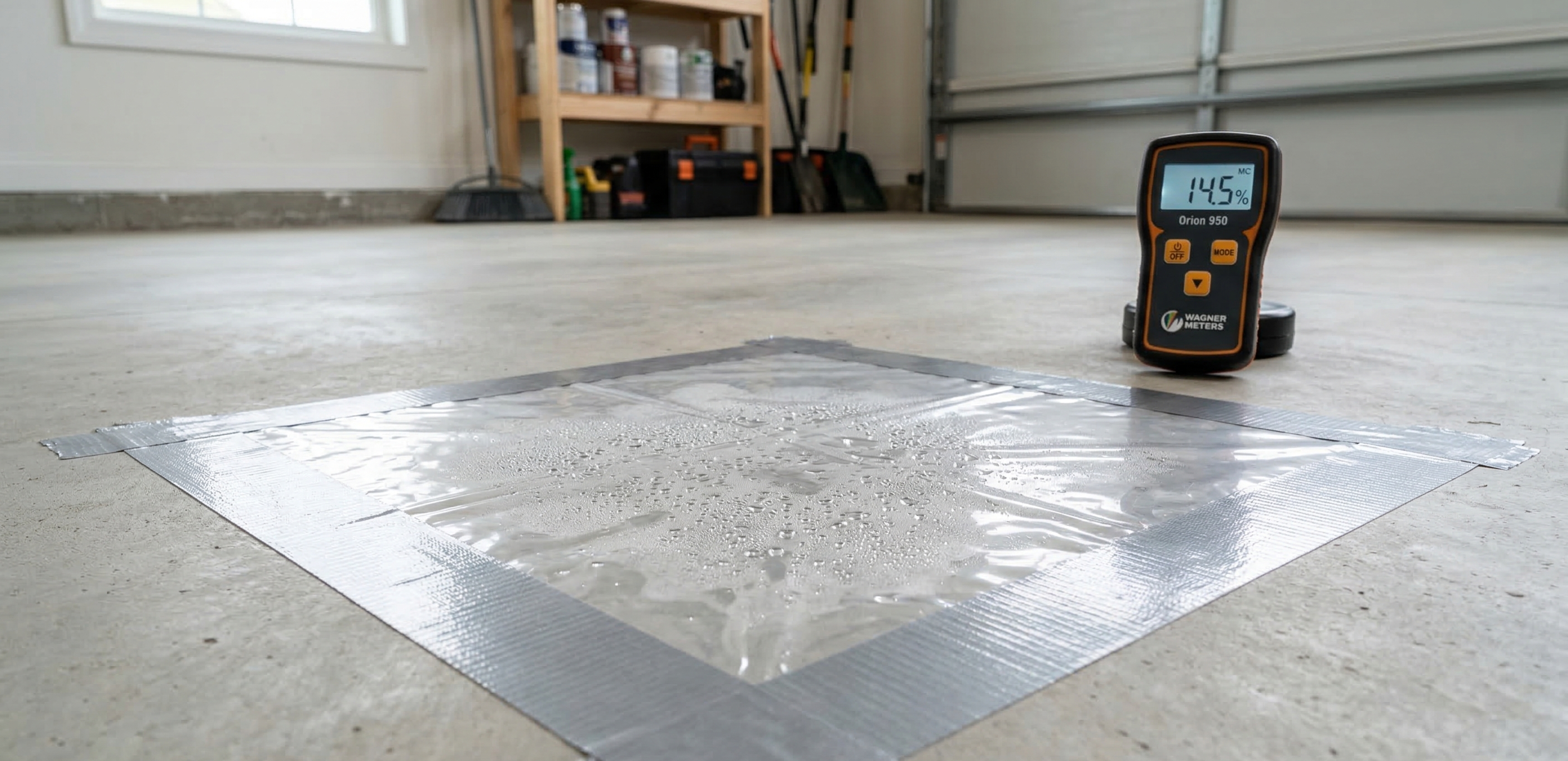
You don't need a £500 moisture meter to get a "Go / No-Go" answer. You just need a bin bag and some duct tape.
-
Prep: Clear a 2ft x 2ft area of the floor. It must be clean and free of oil.
-
Seal: Tape a heavy-duty plastic sheet (or a thick bin bag cut open) to the floor.
-
Secure: Use high-quality duct tape to seal every inch of the edge. It must be airtight.
-
Wait: Leave it for 24 hours. Do not touch it.
-
Inspect: Peel it back.
-
PASS: The concrete under the plastic looks exactly the same colour as the rest of the floor, and the plastic is dry.
-
FAIL: The concrete is darker (damp) or there are water droplets on the underside of the plastic.
If you fail this test, you cannot use standard floor paint. The moisture levels are too high.
Method 2: The Calcium Chloride Test
If you want a scientific number, you can buy a "Calcium Chloride Test Kit." This measures the exact weight of moisture leaving the slab over 60-72 hours.
-
Safe Limit: Generally, if the rate is over 3 lbs per 1,000 sq. ft., standard coatings are risky.
What If My Floor is Damp?
If you have rising damp in your garage, you don't have to leave it bare. But you do have to change your specification.
Standard paints will blister. You need a Damp Tolerant Primer. These are special 2-part epoxy primers designed to adhere to wet concrete and hold back the hydrostatic pressure. They effectively create a new damp-proof membrane on top of the floor.
Conclusion
Checking for damp takes 24 hours and costs nothing but a piece of plastic. Ignoring it costs hundreds in failed materials and days of scraping.
If your plastic sheet test comes up dry, you are safe to proceed with our standard Polyurethane Primer. If it comes up wet, stop. Do not gamble. Switch to a damp-proof system or contact our technical team for a custom specification.
Share:
What is Laitance? Why You Must Remove the Surface Chalk
The Ultimate DIY Garage Floor Prep Guide: Cleaning, Patching, and Profiling