

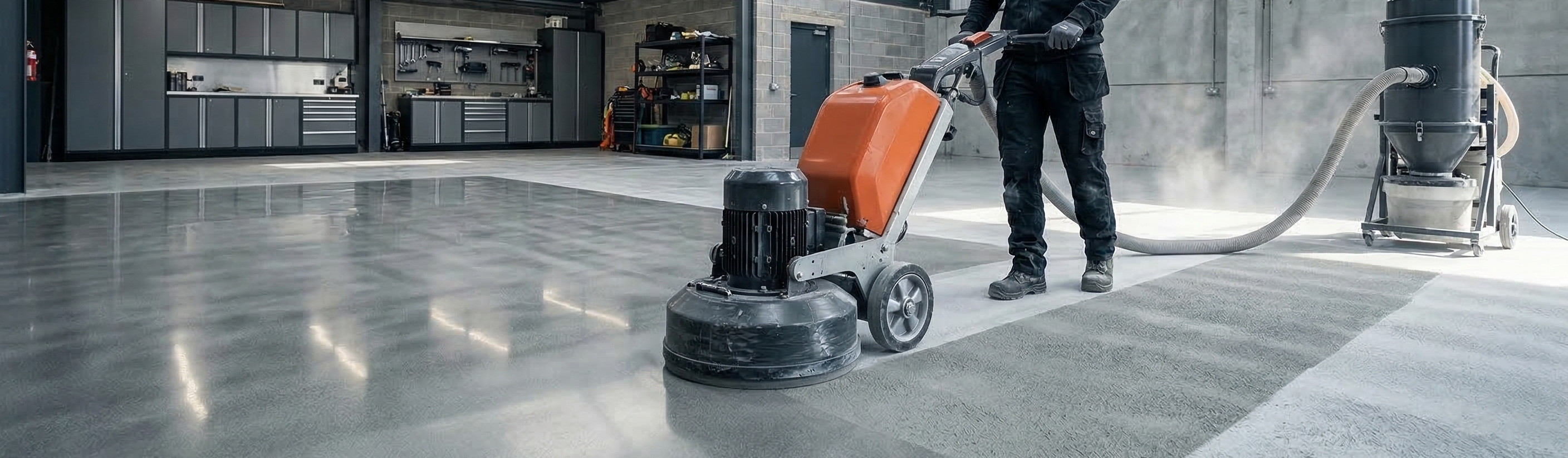
You walk into a newly built warehouse or a high-spec garage. The concrete floor is stunning. It is polished, dark grey, and so smooth it shines like glass. You think: "This will be easy to paint. It’s already flat."
Stop. That shine is a warning sign. This is Power-Floated Concrete, and it is the single most difficult surface to bond resin to. If you apply epoxy directly to this surface, it will peel off in large, plastic sheets within months.
The "smoothness" you see is actually a hardened, impenetrable crust. To get paint to stick, you will have to destroy that beautiful finish. You need Mechanical Keying to allow the paint to find traction and grab onto the surface.
Here is why power-floated floors reject paint, and the heavy machinery you need to fix it.
1. What is Power-Floating?
When a concrete slab is poured, contractors use large machines with spinning metal blades to smooth the wet concrete. This process does two things:
-
Levels the floor: It pushes down the aggregate (stones).
-
Densifies the Surface: It brings the "cement paste" and fine sands to the top and compresses them into an incredibly dense, non-porous "cap."
Often, a Curing Agent or spray-on sealer is applied during this process to stop the concrete drying too fast. The result is a surface that is essentially waterproof and chemically inert.
2. The Adhesion Problem
Epoxy and resin need to soak into the concrete to create a bond (like a tree root system).
-
On Standard Concrete: The pores are open. The resin flows in.
-
On Power-Floated Concrete: The pores are crushed shut. The resin sits on top.
Because the surface is so smooth, there is no friction. Because it is so dense, there is no absorption. It is like trying to paint a pane of glass with water; it just beads up and wipes off.
3. Why Acid Etching Will Fail
We often see DIYers try to use Acid Etch on power-floated floors to avoid renting a grinder. This rarely works.
-
The Sealer Barrier: If the floor has a curing agent (which most power-floated floors do), the acid cannot touch the concrete. It just sits on the sealer and does nothing.
-
The Density: Even if there is no sealer, the concrete paste is so compressed that the acid struggles to burn through the "crust" evenly. You end up with a patchy, unreliable etch that leads to patchy adhesion.
4. The Solution: Mechanical Profiling
You must physically remove the top 1mm–2mm of the floor to expose the porous concrete underneath. This is called "breaking the cap." You have two choices: Shot Blasting or Diamond Grinding.
Option A: Captive Shot Blasting (The Industrial Standard)
This machine fires thousands of tiny steel balls (shot) at the floor at high velocity. The shot hits the concrete, shatters the hard surface, and bounces back into the machine to be recycled.
-
The Result: It creates a rough, textured surface (CSP 3 or 4) that looks like coarse sandpaper.
-
Best For: Large open areas (warehouses), thick screeds, or high-build coatings (1mm+).
-
Pros: Extremely fast, dust-free, and creates the strongest possible key.
-
Cons: Can leave "tramlines" (overlap marks) which might show through thin coatings.
Option B: Diamond Grinding (The Aesthetic Choice)
This uses heavy rotary machines with diamond-tipped segments to sand the floor.
-
The Result: A smoother, flatter profile (CSP 2). It feels like 80-grit sandpaper.
-
Best For: Garages, retail spaces, and thinner roll-coat systems where you want a flat finish.
-
Pros: Removes the shine without creating deep texture.
-
Cons: Slower than shot blasting. You must ensure you grind enough to remove the full cap (look for the colour change in the concrete).
5. The "White Stress" Marks
How do you know if you have ground deep enough? Power-floated concrete is usually dark grey. The concrete underneath is usually lighter. When you grind, you should see a distinct colour shift.
-
Dark Spots: You haven't gone deep enough. The cap is still there.
-
Uniform Light Grey: You have exposed the open matrix.
Conclusion
Power-floated concrete is excellent for bare durability, but it is "hostile" to coatings. You cannot skip the prep. If you have a power-floated floor, put the roller down and pick up the phone to a tool hire company.
-
Don't acid etch.
-
Don't just clean.
-
Grind it until the shine is gone.
Share:
Dealing with "Dusting" Concrete: Hardening Weak Surfaces
Restoring Uneven Floors with Self-Levelling Compounds