

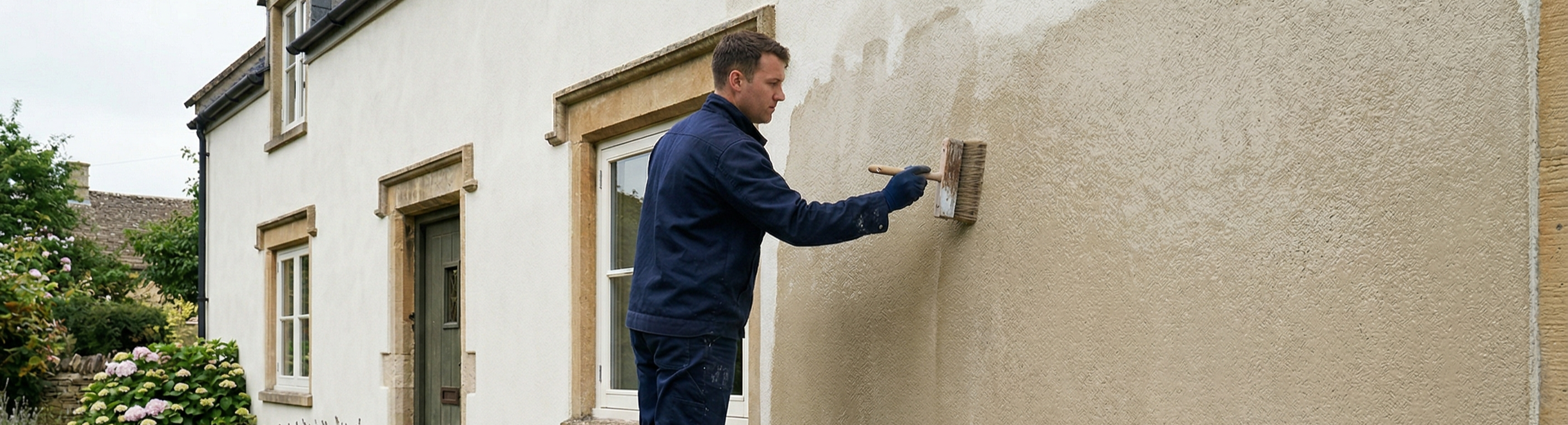
You have just finished rendering a wall, or perhaps you are painting a bare pebble dash for the first time. You apply your first coat of expensive masonry paint. It looks great while wet. But as it dries, it turns into a disaster. Some patches are dark, some are light. You can see every roller mark. It looks like a checkerboard.
This is called "Flashing" or "Grinning." It happens because the wall is thirsty. New render, concrete, and stucco are highly porous. They suffer from "High Suction." When you put thick paint on them, they suck the water (or solvent) out of the paint instantly - before the resin has time to form a proper film.
To get a flawless, uniform finish, you must satisfy the wall's thirst first. You need to Kill the Suction. Here is how to prime porous masonry properly.
1. The Science: Why "Suction" Ruins Paint
Imagine trying to spread jam on a dry sponge. The sponge sucks the moisture out of the jam immediately, making it sticky, thick, and impossible to spread evenly. That is your wall.
-
Rapid Dehydration: The dry render pulls the carrier (water) out of the paint too fast.
-
Poor Adhesion: Because the paint dried instantly on the surface rather than soaking in, it sits on top like a skin. It is liable to peel later.
-
Shadowing: Areas with higher suction (e.g., thicker render) absorb more pigment, drying to a different shade than areas with lower suction.
2. Solution A: The "Mist Coat" (The Budget Method)
For most standard cement renders, you don't need a special product. You just need to thin your paint down. This is known in the trade as a "Mist Coat."
-
The Mix: Take your standard water-based masonry paint. Dilute it with clean water.
-
Ratio: Usually 20% to 30% water. (Check the tin; it often says "Thinning for absorbent surfaces").
-
Consistency: It should look like single cream or milk, not yoghurt.
-
The Application: It will be messy. It will splash.
-
Apply it liberally. You want it to soak in.
- The diluted paint travels deep into the pores, clogging them up with pigment.
-
The Result: Once the Mist Coat is dry, the surface is sealed. Your next coat (full strength) will sit nicely on top and dry evenly.
3. Solution B: Specialist Masonry Primers (The Pro Method)
If you are dealing with a difficult surface - like very chalky render, lime stucco, or highly alkaline new concrete - a mist coat might not be enough. You need an Impregnating Masonry Primer or Stabilising Solution.
-
Alkali Resistant Primers: New cement is highly Alkaline (pH 12+). This alkalinity can "burn" standard paint, causing colour fading. A specialist primer blocks this reaction.
-
Stabilisers: As discussed in previous guides, if the surface is dusty as well as porous, a Mist Coat will just roll off the dust. You need a Stabiliser to glue it down first.
4. The "Water Flick" Test
How do you know if you need to prime? Flick clean water from a brush onto the bare wall.
-
Sucks in instantly: (Disappears in < 30 seconds). High Suction.
-
Action: You MUST apply a Mist Coat or Primer.
-
Sits on surface: (Runs down in rivulets). Low Suction.
-
Action: You can probably paint directly, but ensure the surface is clean of grease/mould.
5. Application Tips for Success
-
Don't Over-Thin: If you make the mist coat too watery (e.g., 50% water), you break the binder structure. The paint will turn into coloured dust when it dries. Stick to the 20-30% rule.
-
Use a Long Pile Roller: Porous surfaces are usually rough. Use a long pile (sleeve) to get the liquid deep into the pits and texture.
-
Keep a Wet Edge: Even with a primer, porous walls dry fast. Work in small sections so you don't get "lap marks" where wet paint overlaps dry paint.
Conclusion
Painting raw masonry is not like painting a previously painted wall. You are filling a sponge. Don't waste an expensive topcoat trying to fill the pores. Use a cheap, diluted first coat to do the hard work.
-
Test the suction.
-
Dilute the first coat.
-
Seal the pores.
Painting new render?
→ Shop our range of Trade Masonry Paints and High-Performance Primers.
Share:
The Tape Test: Diagnosing Unstable Masonry Before Painting
Repairing Blown Render: Patching Holes Before You Paint