

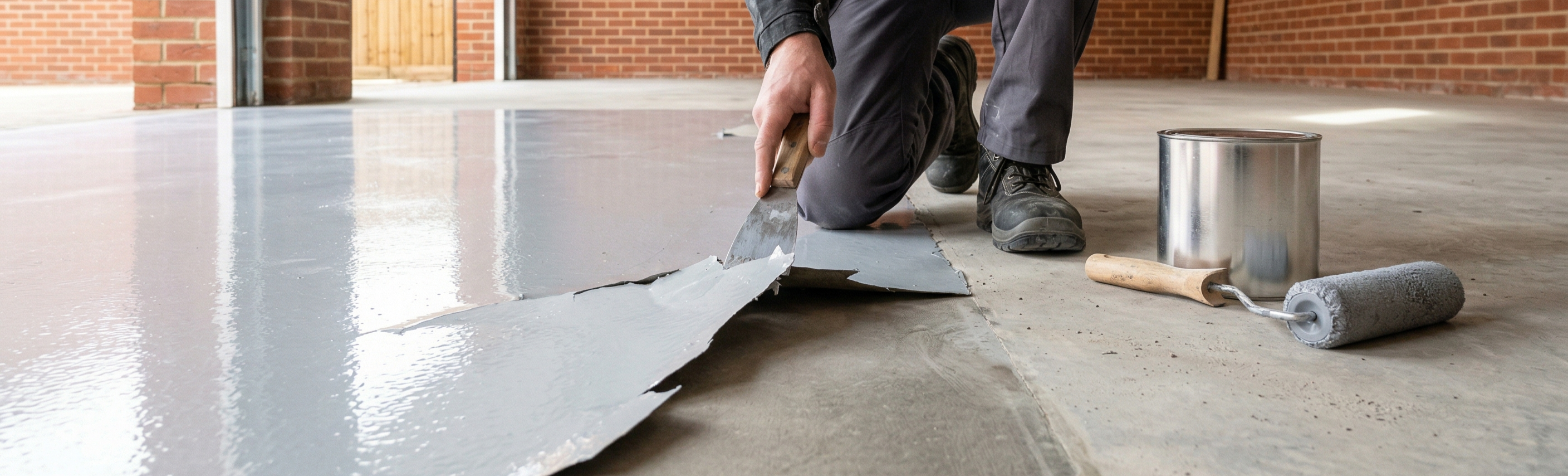
Les défaillances d'adhérence sur les bétons spécialisés - tels que les sols lissés à l'hélicoptère, auto-nivelés ou imprimés - sont presque toujours causées par une surface non poreuse. Ces techniques de finition créent une couche supérieure dense, "vitreuse", qui empêche la peinture de pénétrer le béton. Sans une structure de pores "ouverte" pour s'ancrer, le revêtement reste simplement à la surface ; toute contrainte mécanique (comme les pneus de voiture ou le passage piéton) entraînera le décollement de la peinture par plaques.
-
La surface non poreuse : Le lissage à l'hélicoptère utilise des machines lourdes pour "repasser" le béton à plat, scellant les capillaires de surface et le rendant imperméable aux liquides.
-
La couche de laitance : Les composés auto-nivelants développent souvent une couche supérieure faible et poussiéreuse appelée "laitance" pendant le processus de séchage, qui agit comme une barrière à l'adhérence.
-
La solution : Vous devez "ouvrir" le béton mécaniquement ou chimiquement. Si l'eau ne peut pas pénétrer dans le sol, la peinture ne peut pas y adhérer.
→ Acheter EverFlor - Etch and Clean
→ Acheter EverFlor - Dégraissant
Les coupables techniques : Pourquoi votre sol rejette la peinture
D'après notre expérience, la grande majorité des appels de dépannage concernant la peinture qui s'écaille sont liés à l'un de ces trois types de substrats. Chacun présente un défi unique pour le "lien mécanique" requis pour un revêtement réussi.
1. Béton lissé à l'hélicoptère
Le lissage à l'hélicoptère est un processus de finition où une machine avec des lames rotatives "taloche" le béton humide jusqu'à ce qu'il soit parfaitement lisse et incroyablement dense. Bien que cela soit esthétique et très résistant, cela "ferme" efficacement les pores du béton.
-
Le problème : La tension superficielle du béton est si élevée que les molécules de peinture ne peuvent pas pénétrer. C'est comme essayer de peindre une feuille de verre.
2. Chape et composés auto-nivelants
Ceux-ci sont utilisés pour niveler les sols inégaux avant une finition finale. Pendant le processus de durcissement, l'eau migre vers la surface, entraînant avec elle de fines particules de ciment et de chaux.
-
Le problème : Cela crée de la laitance - une couche mince, cassante et laiteuse. Bien qu'elle semble solide, elle est structurellement faible. Lorsque vous peignez par-dessus, la peinture adhère à la laitance, mais la laitance n'est pas correctement fixée au sol. La peinture finit par arracher la laitance avec elle.
3. Béton imprimé et traité
Le béton estampé, coloré ou traité avec des "membranes de cure" ou des "durcisseurs" contient souvent des cires ou des silicates.
-
Le problème : Ces additifs sont conçus pour repousser l'humidité et les taches. Malheureusement, ils repoussent également la peinture. S'ils ne sont pas retirés, le revêtement "rampera" ou perlera pendant l'application et ne s'adhérera pas.
La solution : Les "trois piliers" de la préparation
Pour corriger ou prévenir les défaillances d'adhérence, vous devez transformer le sol d'un état "non poreux" à un état "assoiffé". Cela nécessite une approche systématique de la préparation.
Gravure mécanique ou chimique
Vous devez créer un "profil" (rugosité microscopique) sur lequel la peinture pourra s'accrocher.
-
Gravure à l'acide : L'utilisation d'une solution acide spécialisée réagit avec la chaux libre du béton pour ronger la couche supérieure "vitreuse", ouvrant ainsi les capillaires.
-
Gravure mécanique (ponçage) : Pour les sols lissés à l'hélicoptère très denses, le ponçage mécanique est la référence. Il élimine physiquement la couche supérieure du béton pour révéler l'agrégat poreux en dessous.
→ Lisez notre Guide sur la Gravure à l'acide ou mécanique
Élimination de la laitance
Si vous avez affaire à un composé auto-nivelant, vous devez éliminer la couche superficielle poussiéreuse.
-
La méthode : Cela se fait généralement par un léger ponçage ou un "brossage" avec une brosse dure et de l'eau. Si vous pouvez rayer la surface avec une pièce de monnaie et produire une poudre blanche, la laitance est toujours présente et nécessite un travail supplémentaire.
→ Lisez notre guide sur Comment identifier et éliminer la laitance du béton
Nettoyage et dégraissage
Même un sol parfaitement gravé échouera s'il y a une contamination "invisible" comme de l'huile, de la graisse ou du silicone de pneu.
-
La méthode : Utilisez un dégraissant industriel puissant. Les détergents ménagers standard contiennent souvent de la "lanoline" ou des huiles qui peuvent causer d'autres problèmes d'adhérence.
→ Consultez notre Guide pour nettoyer et dégraisser le béton
Comment tester votre sol avant de peindre (Le test "Éponge")
Avant d'ouvrir une seule boîte de peinture, vous devriez effectuer le Test de la goutte d'eau.
Versez une petite quantité d'eau sur différentes parties de votre sol sec.
-
Réussite : Si l'eau assombrit le béton et disparaît en 30 à 60 secondes, votre sol est poreux et prêt à être peint.
-
Échec : Si l'eau perle comme sur une voiture fraîchement cirée, ne peignez pas. Vous devez répéter votre processus de gravure ou de ponçage jusqu'à ce que l'eau pénètre.
Compromis honnêtes : Temps de préparation vs. Durée de vie du projet
Les coûts de la précipitation : La préparation est la partie la moins agréable du travail, prenant souvent 80 % du temps total du projet. Cependant, un sol correctement gravé et nettoyé durera plus de 10 ans. Un sol peint sur une surface lissée à l'hélicoptère non préparée échouera souvent dans les 6 premiers mois.
Le mythe de l'apprêt : De nombreux clients demandent s'ils peuvent simplement utiliser un "apprêt plus puissant" pour éviter le ponçage. Dans le monde du béton lissé à l'hélicoptère, il n'y a pas d'"apprêt magique" qui puisse surmonter une surface fermée. L'apprêt a besoin de pores pour s'y loger ; si les pores sont fermés, l'apprêt échouera aussi vite que la couche de finition.
Partager:
Le sol peint est-il trop glissant ? Avantages et applications de la peinture antidérapante pour sol